Equal Splitting: When 50/50 Works (and When It Fails)
Equal splitting feels fair, but 50/50 quietly fails when incomes differ or consumption is unequal. Learn when equal splitting works, when it builds resentment, and what methods work better for your situation.

Quick Answer
When does equal 50/50 splitting work, and when does it fail?
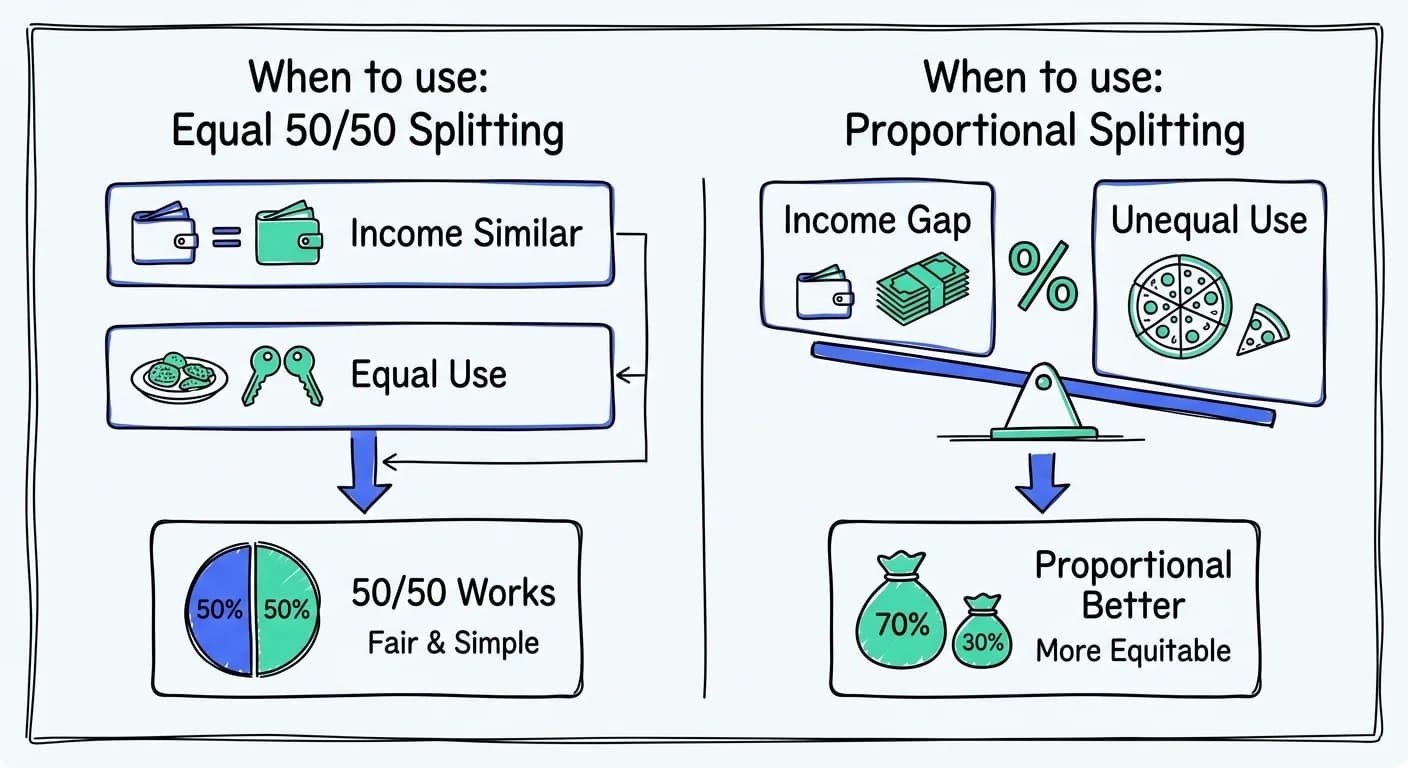
Equal splitting works well when everyone in the group earns similar incomes and consumes roughly the same amount. It fails when income levels differ significantly, consumption is unequal, or one person's needs are not reflected in their share of the bill.
The Appeal of 50/50: Simple, Fast, No Calculator Required
Splitting a bill equally is the default for most people. It is fast, skips awkward conversations, and looks fair on the surface. You each owe $30. Done.
But that surface fairness hides a lot. Two people splitting a $60 dinner equally feels fine when both ordered the same. It feels different when one had the steak and wine, and the other had a salad and water. The math is identical. The fairness is not.
Here is when 50/50 is the right call, when it quietly builds resentment, and what to use instead when equal splitting does not fit your situation.
When 50/50 Actually Works
Equal splitting earns its reputation in the right conditions. Three factors predict whether 50/50 will feel fair to everyone involved.
Similar Incomes
When two people earn roughly the same, splitting equally is genuinely equitable. Both are giving up the same percentage of their income for the same shared cost. No one is quietly stretched while the other barely notices the expense.
Two young professionals on $60K each splitting a $2,000/month apartment at $1,000 each? That is fair. The financial burden is symmetric. Neither person's savings take a disproportionate hit.
Equal Consumption
When everyone uses or consumes roughly the same amount, equal splitting reflects reality. Four friends renting a Netflix account together. A group of five ordering similarly-priced dishes at dinner. Flatmates splitting internet and electricity.
The moment consumption becomes unequal, the logic of equal splitting starts to fray. One person streaming 10 hours a day, another barely using it. One flatmate running the heating constantly, another who is rarely home. Same bill, very different story.
Convenience Is the Real Goal
Sometimes the value of equal splitting is the simplicity itself. A group of colleagues doing a team lunch together. Friends at a birthday dinner where the point is celebrating, not counting prawns. Low-stakes, one-off situations where tracking exactly who had what creates more friction than it resolves.
The key word is low-stakes. For a $15 lunch once in a while, the overhead of itemized splitting outweighs the small inequity. For a $1,500 monthly rent arrangement, it does not.
When 50/50 Fails (and Why)
Equal splitting runs into trouble in predictable places. The friction is rarely dramatic at first. It builds over months of small transactions, until someone feels taken advantage of and finally says something.
Income Inequality
This is where 50/50 breaks down most often. When one person earns significantly more, equal splitting is mathematically equal but not proportionally fair. A $1,000 monthly rent feels manageable on $80K/year and tight on $40K/year. The dollar amounts are the same. The percentage of take-home pay is not.
Research published by PMC found that disagreements over "unfair relative contributions" account for 14.5% of all couple money fights, with rent and mortgage disputes representing 13.3%. These are not abstract arguments. They are real conflicts that damage relationships.
A 2025 article in Le Monde called 50/50 splitting "a scam" for couples with different incomes, particularly for women who statistically earn less over a lifetime. The World Bank estimated women earn roughly 82 cents for every dollar earned by men globally, meaning an equal dollar split is an unequal sacrifice.
Unequal Use or Consumption
You ordered the salad. Your friend ordered the ribeye and two glasses of wine. Splitting equally means you subsidized their meal. Done once, it barely registers. Done consistently, it grates.
The same applies to utilities. If one flatmate works from home while the other is out from 8am to 6pm, their heating, electricity, and broadband usage looks nothing alike. Equal splitting punishes the lower user and rewards the higher user with a hidden subsidy.
Dietary Differences and Lifestyle Choices
Shared grocery shopping gets complicated fast when one person is vegan and the other buys expensive meat and specialty cheeses. Splitting the grocery bill equally means the lower-spending person pays for items they never touch.
Restaurant bills have the same problem. Someone following dietary restrictions or eating less for health reasons, but splitting the full bill evenly, ends up paying for what amounts to other people's choices.
The Relationship Cost of Getting It Wrong
Money arguments are one of the most common causes of relationship friction, and equal splitting that does not fit the situation is a slow drip of resentment. Research from a 2023 PMC study found that couples who fight about money more frequently report worse relationship satisfaction and reduced emotional responsiveness toward each other.
What makes it worse is that the person being disadvantaged often does not raise it immediately. They absorb it, rationalize it, and quietly build a ledger in their head. By the time it surfaces as an argument, months of compounded frustration come with it.
One account from The Financial Diet described how rigidly splitting everything 50/50 with a partner who earned significantly more contributed directly to a breakup. The lower-earning partner depleted their savings trying to keep up, lost financial independence, and eventually the relationship did not survive the strain.
Common Scenarios Where 50/50 Breaks Down
| Scenario | Why 50/50 Fails | Better Approach |
|---|---|---|
| Rent with income gap | Lower earner pays larger share of take-home pay | Proportional split based on income |
| Restaurant with unequal orders | Low spender subsidizes high spender | Itemized split or pay-for-your-own |
| Utilities with different usage | Remote worker pays same as rarely-home flatmate | Usage-based or proportional split |
| Groceries with different diets | Person A pays for Person B's specialty items | Separate baskets or itemized approach |
| Group holiday with different budgets | Budget traveller funds luxury preferences of others | Budget-agreement upfront, proportional |
| One partner owns the home | Renter pays 50% but builds zero equity | Rent-equivalent or proportional model |
Interactive Embed
Interactive widget placeholder
What to Use Instead When 50/50 Does Not Fit
There is no shortage of alternatives. The key is choosing the method that fits your specific situation, and agreeing on it openly rather than letting the default carry you into resentment. Our guide to bill splitting methods covers each of these in detail.
Proportional Splitting
Each person contributes the same percentage of their income rather than the same dollar amount. If one person earns twice as much, they pay roughly twice as much toward shared costs. Couples who switch to proportional splitting often describe it as the moment their financial dynamic started feeling genuinely fair.
Her First $100K describes using a 70/30 split with their partner because of an income gap, noting it was "more equitable" for their situation. Proportional splitting requires transparency about incomes, which some couples find uncomfortable at first but ultimately strengthening.
Itemized Splitting
Pay for what you actually consumed. Works best for restaurants, grocery runs with different dietary needs, or any expense with clear line items. It removes ambiguity and means no one subsidizes someone else's choices.
This is where a tool like OweMeter helps. You can add individual line items to an expense, assign specific people to each item, and let the app calculate exactly what everyone owes without anyone doing the mental math at the table.
The Joint + Personal Account System
Many couples use a hybrid system: a joint account for shared expenses (proportionally funded based on income), and separate personal accounts for individual spending. This gives both people financial autonomy while ensuring shared costs are covered equitably.
The structure is straightforward. Each person contributes a percentage of their income to the joint account each month. Everything shared comes out of that. Personal purchases come from personal accounts. No awkwardness, no tracking individual coffees.
Task-Based Trades
Sometimes the fairest split is not financial at all. One person handles rent, the other handles groceries. One earns more but works longer hours, so the other takes on more household tasks. This works best when both people genuinely agree the trade is balanced and revisit it as circumstances change.
A Note on Group Splits Beyond Couples
Equal splitting among friends and flatmates follows the same logic. It works when everyone is in a similar financial position and consuming similarly. It breaks down when there is a significant income spread within the group, or when lifestyle differences mean people are not actually using the same amount.
For flatmates, the income-based conversation can feel intrusive if you are not close. An easier starting point is consumption-based splitting for variable costs like electricity and groceries, while keeping rent equal if rooms are the same size. If room sizes differ, splitting rent fairly using a room-value method is worth considering.
For tracking group expenses across multiple people and multiple categories, a dedicated tool removes the spreadsheet headache. OweMeter lets you track group balances, set up recurring expenses, and settle up without anyone losing track of what is owed.
How to Have the 50/50 Conversation
The research is consistent on one point: explicit money agreements are the single most reliable predictor of financial harmony in shared living or relationship contexts. The method matters less than the conversation.
If you have been quietly uncomfortable with a 50/50 arrangement, the way to raise it is with context, not accusation. "I have been thinking about how we split costs, and I am wondering if we could look at an approach that accounts for our different incomes" is a very different conversation opener than "this feels unfair to me."
Come with a specific alternative in mind. Saying "I think proportional splitting based on income would work better" gives the other person something concrete to respond to. Vague discomfort is harder to resolve than a specific proposal.
Frequently Asked Questions
The Bottom Line
Equal splitting is a reasonable default when everyone is on similar financial footing and consuming similar amounts. It stops being reasonable the moment those conditions stop being true.
The good news is that better alternatives exist for every scenario. Proportional splitting for income gaps. Itemized splitting for unequal consumption. Hybrid systems for ongoing shared living. The method you choose matters less than whether both people feel heard and treated fairly.
For a deeper look at all your options, see our complete guide to splitting bills fairly and our breakdown of 5 bill splitting methods compared. If you are dealing with a significant income gap, our guide on how to split bills based on income walks through the practical steps.
Related Articles
Frequently Asked Questions
Is equal 50/50 splitting fair?
Equal splitting is fair when both people have similar incomes and consume similar amounts. It becomes unfair when there is a significant income gap, because the lower earner is giving up a larger percentage of their pay for the same shared cost.
When should you stop splitting equally?
Consider moving away from 50/50 when one person earns significantly more than the other, when consumption is clearly unequal (different orders, different usage levels), or when one person is consistently struggling to meet their share while the other has no trouble.
What is a fair alternative to 50/50 splitting?
Proportional splitting based on income percentage is the most common fair alternative for couples or ongoing shared arrangements. For restaurants and groceries, itemized splitting (paying for what you actually ordered or took) is practical and removes any guesswork.
Can 50/50 splitting ruin a relationship?
A rigid 50/50 arrangement that does not account for income or consumption differences can build resentment over time. Research shows that perceived financial unfairness is a significant contributor to relationship dissatisfaction and conflict, particularly when the disadvantaged person stays silent about it.
How do couples decide how to split expenses?
Research shows 59.7% of couples use fully joint finances, while others use a mix of joint and separate accounts. Successful couples tend to share one trait in common: they had an explicit conversation about their arrangement rather than letting a default carry them.
Related Articles

April 11, 2026
The Psychology of Bill Splitting
Bill splitting gets tense when the rule feels invisible, uneven, or unspoken. Here is why shared expenses trigger resentment, and how to make them feel fair without turning life into admin.

April 8, 2026
How to Split Recurring Bills Fairly
Recurring bills are easy to ignore until they stop feeling fair. Here is a practical system for splitting rent, utilities, subscriptions, pet costs, and shared household expenses in a way that fits real life and still works a few months later.

April 4, 2026
Itemized Splitting: A Step-by-Step Guide
Itemized splitting means each person pays only for what they ordered. This step-by-step guide covers restaurants, shared household bills, and group trips, with scripts for handling the social side smoothly.

March 28, 2026
How to Split Bills Based on Income
The exact formula for splitting shared bills proportionally by income. Includes step-by-step examples for flatmates, couples, and groups, plus when to use income-based vs equal splitting.