How to Split Bills Based on Income
The exact formula for splitting shared bills proportionally by income. Includes step-by-step examples for flatmates, couples, and groups, plus when to use income-based vs equal splitting.

Quick Answer
How do you split bills based on income?
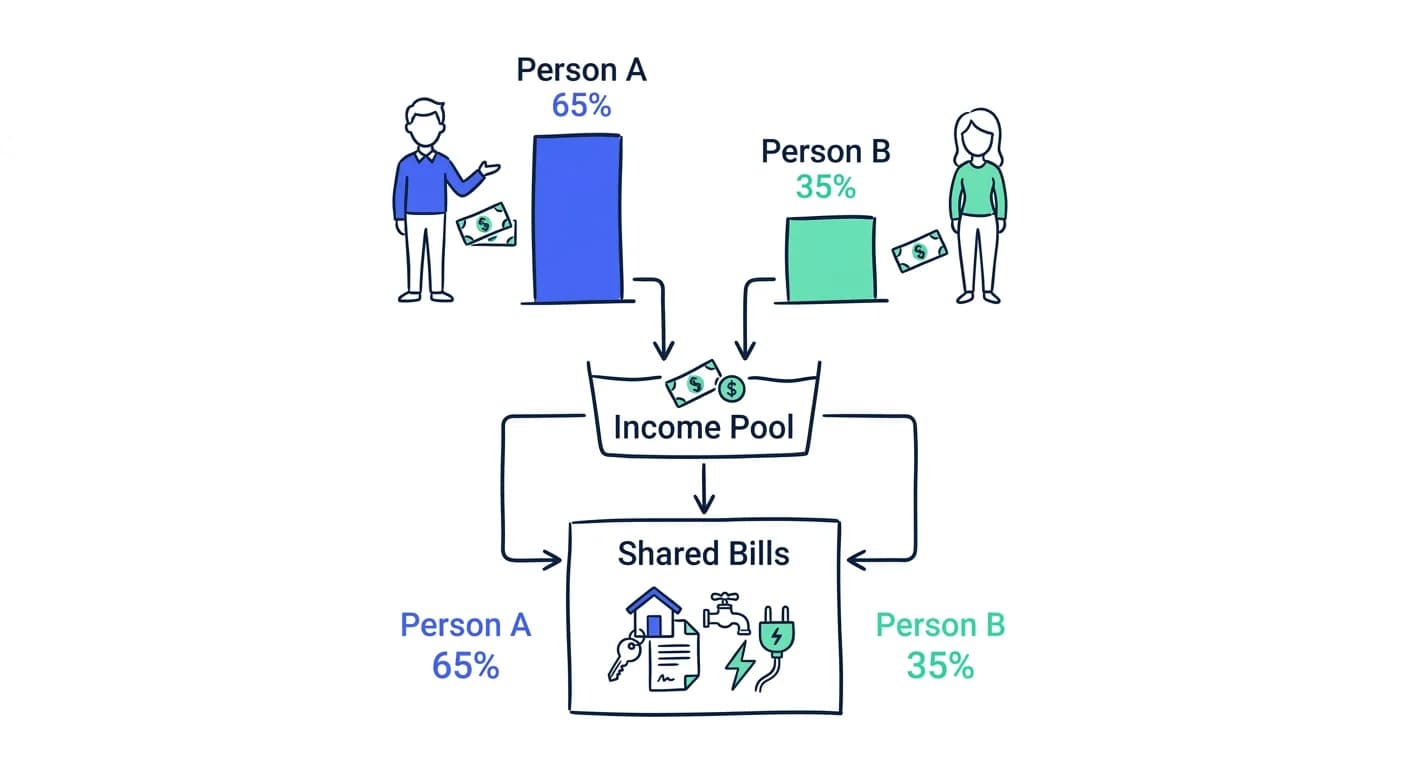
Add up everyone's take-home income, then divide each person's income by the total to get their percentage share. Multiply that percentage by each bill to find what they owe. For example, if one person earns 60% of the household income, they pay 60% of shared bills.
Why 50/50 Splits Don't Always Work
Equal splitting feels simple and fair on the surface. But when two people earn very different amounts, splitting costs down the middle can leave the lower earner genuinely struggling while the higher earner barely notices the expense.
Say you earn $3,500 a month and your flatmate earns $2,000. You each pay $900 in rent. That's 25.7% of your income, versus 45% of theirs. Same dollar amount, but a completely different financial impact.
Income-based splitting fixes this. Instead of splitting by head count, you split by earning power. The goal is that both people end up with a similar proportion of their pay left over after shared bills, not that they pay the same dollar amount.
The Income-Based Formula
The math is straightforward. You need two numbers: each person's income and the combined total.
- Your share (%) = Your income / Total combined income x 100
- Your payment = Total bill x your share (%)
How to Calculate Your Split in 3 Steps
- Agree on income figures. Both people share their monthly take-home pay. This is the only number that matters for the calculation.
- Calculate each person's percentage. Divide your income by the total, then multiply by 100. That percentage is your share of every shared bill.
- Apply to each bill. Multiply the bill amount by your percentage. Do this once, and you have your number for rent, utilities, groceries, or any other shared cost.
Once you've worked out the percentages, they stay the same until someone's income changes. You don't need to recalculate every month.
Worked Examples
Two Flatmates with Different Salaries
Sam takes home $3,200/month. Jordan takes home $2,000/month. Combined income: $5,200.
| Sam | Jordan | |
|---|---|---|
| Monthly take-home | $3,200 | $2,000 |
| Income share | 61.5% | 38.5% |
| Rent ($1,400/mo) | $861 | $539 |
| Power ($120/mo) | $73.80 | $46.20 |
| Internet ($80/mo) | $49.20 | $30.80 |
| Total monthly | $984 | $616 |
After bills, Sam has $2,216 left. Jordan has $1,384. With 50/50 splitting, Jordan would pay $800/month in bills and be left with just $1,200 after contributions.
Couples with an Income Gap
Alex earns $5,200/month after tax. Riley earns $2,800/month. Combined: $8,000. Alex has a 65% share, Riley 35%.
| Bill | Total | Alex (65%) | Riley (35%) |
|---|---|---|---|
| Rent | $2,000 | $1,300 | $700 |
| Utilities | $200 | $130 | $70 |
| Groceries | $500 | $325 | $175 |
| Streaming/subscriptions | $60 | $39 | $21 |
| Monthly total | $2,760 | $1,794 | $966 |
Alex takes home $5,200 and contributes $1,794 (34.5% of their pay). Riley takes home $2,800 and contributes $966 (34.5% of their pay). Same proportion. Different amounts. That's the whole point.
A Three-Way Friend Group
Three friends share a house. Monthly take-home: Priya $4,000, Marcus $2,500, Dev $1,500. Total: $8,000.
| Person | Income | Share | Rent of $2,100 |
|---|---|---|---|
| Priya | $4,000 | 50% | $1,050 |
| Marcus | $2,500 | 31.25% | $656 |
| Dev | $1,500 | 18.75% | $394 |
| Total | $8,000 | 100% | $2,100 |
When to Use Income-Based Splitting
Proportional splitting works well in specific situations. It's not always necessary, but it matters a lot when the conditions are right.
- Income gap above 25-30%. Below that threshold, 50/50 is close enough that the complexity of proportional splitting isn't worth it.
- Long-term shared living. For flatmates, couples, or families sharing costs for months or years, proportional splitting compounds over time.
- One person is on reduced income. A partner on parental leave, a student, or someone between jobs is in a temporary income gap that proportional splitting handles fairly.
- Joint bills that are fixed costs. Rent, power, and internet are predictable. These are ideal for income-based splits because you can calculate once and lock it in.
- You want to preserve the relationship. Financial stress is one of the biggest sources of conflict in shared living. A split that feels fair reduces friction.
Hybrid Approaches That Actually Work
You don't have to apply income-based splitting to everything. Many people use a hybrid: proportional for fixed shared costs, equal for smaller variable ones.
- Proportional rent, equal utilities. Rent is the biggest cost, so proportional splitting matters most there. Equal utilities keeps things simple for small shared bills.
- Proportional for housing, 50/50 for food. Groceries are harder to track exactly, and the gap is smaller, so equal splitting for shared meals often works fine.
- 70/30 compromise. If full proportional splitting feels too stark, split the difference between 50/50 and full proportional. A couple with a 60/40 income split could agree on a 55/45 cost split.
- Income-based for fixed bills, itemized for dining out. Use itemized splitting when people order differently at restaurants or grab different groceries.
Interactive Embed
Interactive widget placeholder
Having the Income Conversation
Talking about income feels awkward. Most people don't share their salary with flatmates or even close friends. Here's how to make it easier.
- Frame it as fairness, not judgment. Say "I want us both to feel good about this" rather than "I think you should pay more."
- Use take-home pay, not salary. After-tax income is less sensitive than gross salary and is the number that actually matters for the calculation.
- Share ranges if exact numbers feel too personal. "I take home around $3,000-3,500" is enough to calculate an approximate split.
- Revisit when incomes change. A pay rise, job loss, or career switch should trigger a new calculation. Build in a review every 6-12 months.
- Put it in writing. A simple note or shared document with agreed percentages prevents memory drift and arguments later.
Tracking Your Custom Split
Once you've agreed on percentages, the next challenge is tracking who paid what. Our complete guide to splitting bills fairly covers every tracking method, from shared spreadsheets to dedicated apps.
OweMeter lets you add expenses and log what each person owes. For income-based splits, calculate each person's share upfront (using the formula above), then enter the amounts when you add the expense. The app tracks balances, sends reminders, and shows exactly where things stand across your whole group.
For specific expense amounts, OweMeter's itemized splitting feature lets you assign line items to individual people, which works well when some costs are shared proportionally and others are individual. You can also save templates for recurring bills so you're not re-entering the same numbers each month.
Common Objections, Answered
"Why should I pay more just because I earn more?"
You're not paying more in proportion, you're paying the same percentage of your income. Both people end up contributing the same fraction of their take-home pay. The argument for 50/50 is simplicity, not fairness: it only feels equal because the dollar amounts match.
"This seems too complicated."
The one-time calculation takes about 5 minutes. After that, the percentages stay fixed until someone's income changes. It's more setup than 50/50, but less ongoing conflict and resentment.
"What about non-financial contributions?"
Chores, cooking, and maintenance are legitimate contributions that don't show up in income numbers. If one person handles significantly more housework, that's worth factoring in, either as a separate conversation or by adjusting the split slightly. Income-based splitting handles money; the rest needs a different discussion.
"Income changes. It's hard to keep up."
Set a review schedule, usually every 6-12 months or when someone's income changes significantly. Treat it like any other shared household admin. A quick 10-minute check-in is enough to recalculate and update the split.
Quick Reference: Income-Based vs Equal Splitting
| Factor | Income-Based | Equal (50/50) |
|---|---|---|
| Best for | Significant income gaps (25%+) | Similar incomes |
| Complexity | One-time setup | Zero setup |
| Fairness metric | Same % of income | Same dollar amount |
| Works for groups of 3+ | Yes (scales well) | Yes |
| Review needed | When incomes change | Rarely |
| Good for couples | Yes, especially with career changes | Yes, when earnings are close |
For more ways to structure a shared household budget, the 5 bill splitting methods compared guide breaks down every major approach, including usage-based splitting and rotating who pays.
Frequently Asked Questions
Income-based splitting takes about 5 minutes to set up and can save months of financial friction. The formula is simple: calculate each person's share of the combined income, apply it to each bill, and revisit when circumstances change. For flatmates, couples, and friend groups with meaningful income differences, it's the closest thing to a genuinely fair approach. For more on the broader question of which splitting method fits your situation, see our complete guide to splitting bills fairly.
Related Articles
- The Complete Guide to Splitting Bills Fairly - Every method explained with pros, cons, and when to use each
- 5 Bill Splitting Methods Compared - A side-by-side look at equal, proportional, itemized, and more
- Best Expense Tracking Apps for Roommates - Apps that make tracking shared costs straightforward
Frequently Asked Questions
Should you use gross or net income for splitting bills?
Always use net (after-tax) income. Gross salary looks bigger, but it's not money you can actually spend. Using take-home pay gives a more accurate picture of each person's spending power and makes the split feel genuinely fair.
What if one person refuses to share their income?
You can agree on a split ratio without disclosing exact numbers. If both people agree that a 60/40 or 65/35 split feels right, that's enough. The formula is a tool for arriving at a ratio, not a requirement to disclose salaries.
How do you handle income-based splitting in a group of 3 or more?
The formula scales perfectly. Add up everyone's income to get the total, then calculate each person's percentage share. Apply each percentage to the total bill. The math works the same way regardless of how many people are involved.
Does income-based splitting work for irregular or freelance income?
Use a rolling 3-month average of net income. Freelancers and people with variable pay can calculate their average monthly take-home over the past quarter and use that as their baseline. Review it every 3-6 months if income varies significantly.
What happens when one person gets a pay rise?
Recalculate the percentages using the new income figures and update the split going forward. Most people do this at natural review points, such as when a lease renews or at the start of a new year. Small pay rises (under 10%) often don't justify a change.
Pillar Guide
This article belongs to the The Complete Guide to Splitting Bills Fairly cluster.
Related Articles

April 11, 2026
The Psychology of Bill Splitting
Bill splitting gets tense when the rule feels invisible, uneven, or unspoken. Here is why shared expenses trigger resentment, and how to make them feel fair without turning life into admin.

April 8, 2026
How to Split Recurring Bills Fairly
Recurring bills are easy to ignore until they stop feeling fair. Here is a practical system for splitting rent, utilities, subscriptions, pet costs, and shared household expenses in a way that fits real life and still works a few months later.

April 4, 2026
Itemized Splitting: A Step-by-Step Guide
Itemized splitting means each person pays only for what they ordered. This step-by-step guide covers restaurants, shared household bills, and group trips, with scripts for handling the social side smoothly.

April 1, 2026
Equal Splitting: When 50/50 Works (and When It Fails)
Equal splitting feels fair, but 50/50 quietly fails when incomes differ or consumption is unequal. Learn when equal splitting works, when it builds resentment, and what methods work better for your situation.