Itemized Splitting: A Step-by-Step Guide
Itemized splitting means each person pays only for what they ordered. This step-by-step guide covers restaurants, shared household bills, and group trips, with scripts for handling the social side smoothly.

Quick Answer
What is itemized splitting and how does it work?
Itemized splitting means each person pays only for what they personally ordered or consumed, rather than dividing the total equally. You go through the bill line by line, assign each item to the right person, then split shared items only among those who actually consumed them. It takes a few extra minutes but produces a genuinely fair result.
Why Itemized Splitting Matters
You've been there: a table of six, wildly different orders, and someone suggests splitting the bill evenly. The person who had steak and two glasses of wine nods happily. The person who had a salad and sparkling water does the math in their head and says nothing, but feels it.
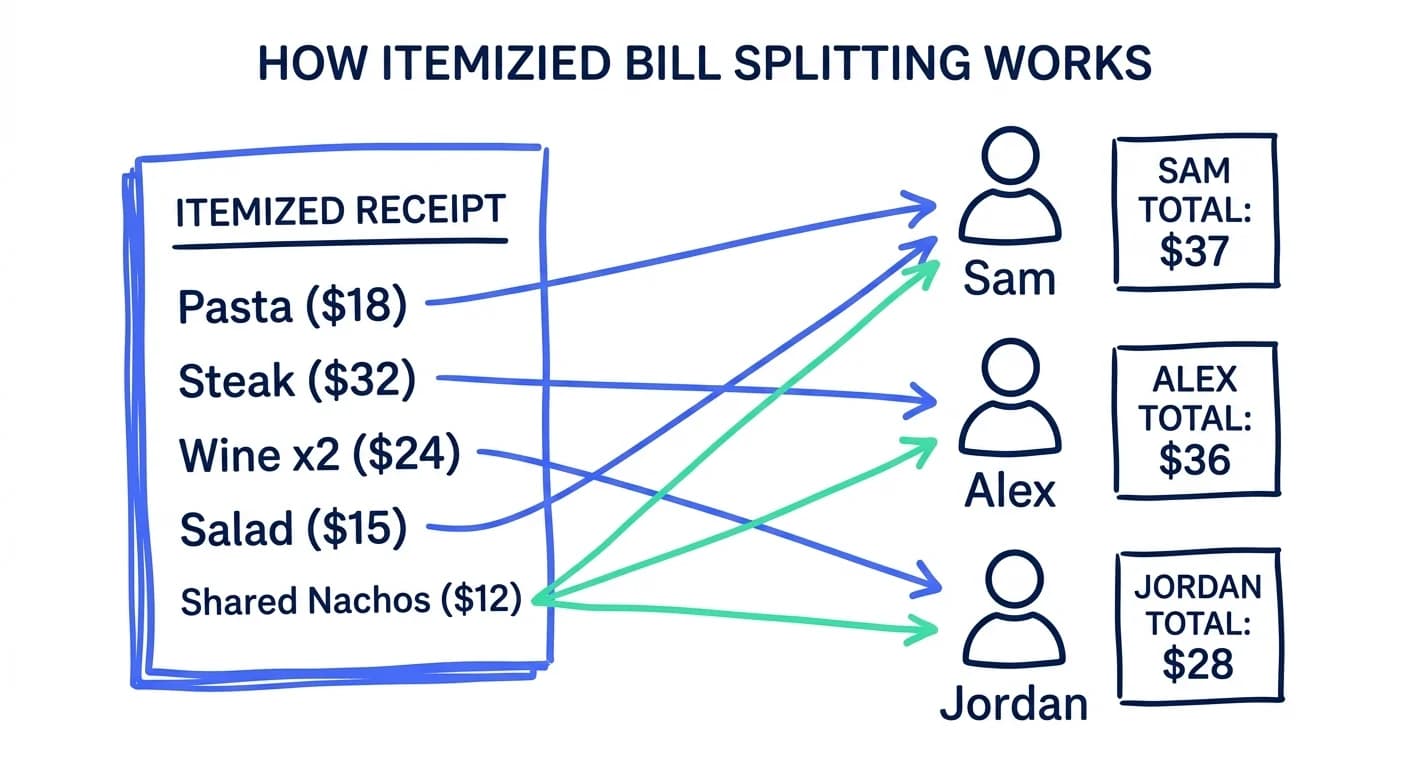
Itemized splitting fixes this. Instead of dividing the total by the number of people, you assign each item to whoever ordered it. Shared dishes get split only among those who ate them. Tax and tip follow proportionally. Everyone pays their actual share.
This guide walks through how to do it smoothly, when it's worth the effort, and how to handle the common tricky scenarios that make even seasoned group diners hesitate. For a broader look at all your splitting options, check out our complete guide to splitting bills fairly.
Itemized vs. Equal Splitting: What's the Difference?
Equal splitting divides the total bill by the number of people. It's fast, requires no conversation, and works well when everyone ordered roughly the same thing. The problem is that 'roughly the same' is rarer than people assume.
| Method | How It Works | Best For | Watch Out For |
|---|---|---|---|
| Equal Split | Total divided by number of people | Casual outings, similar orders | Large price differences, non-drinkers, dietary restrictions |
| Itemized Split | Each person pays for their specific items | Formal dinners, varied orders, large groups | Requires a clear itemized receipt |
| Income-Based | Each person pays a proportion of their income | Ongoing bills with partners or roommates | Requires open income discussion |
| Custom Split | Manually assign specific amounts per person | Irregular one-off situations | Can feel arbitrary without clear logic |
Research consistently shows that equal splitting hides real inequities. At a typical Indian restaurant, vegetarians who split equally with meat-eaters often overpay by around 34%. At mezze-style dining where one person eats lightly, that gap can reach 23%. These aren't small numbers when you're eating out regularly. If you want to understand all five common methods in depth, our breakdown of 5 bill splitting methods compared has the full picture.
Step-by-Step: Itemized Splitting at a Restaurant
The restaurant is where itemized splitting most often comes up, and where most people give up and go equal because they don't have a clear process. Here's one that works.
Before You Order
Set expectations early. A simple 'should we split by what we each order?' said casually while looking at the menu is all it takes. Frame it around the menu prices varying a lot, not around anyone's specific appetite or budget. This keeps it practical rather than personal.
During the Meal
- Track who ordered what as you go, not after the bill arrives
- Decide upfront how shared items (appetizers, a bottle of wine) will be handled
- If some people are drinking and others are not, keep drinks separate from food
- For shared dishes, note who actually ate from them, not just who offered
When the Bill Arrives
- Request an itemized receipt if the restaurant doesn't bring one automatically
- Assign each line item to the person who ordered it
- For shared items, divide that subtotal only among the people who shared them
- Add tax and tip proportionally based on each person's subtotal (not equally)
- Use a splitting app to handle the math and avoid arguments over small rounding differences
Step-by-Step: Itemized Splitting for Household Bills
Splitting household bills between roommates or partners works differently from a one-off restaurant meal. You're dealing with recurring costs at different consumption levels, and the 'itemized' approach here means splitting each type of expense by who actually uses it, rather than going line by line on a single receipt.
The starting point is to list every recurring shared expense, then ask: who uses this, and how much? Rent is usually split equally or by room size. Electricity might reflect usage. Streaming subscriptions might be shared by all, while one person's gym membership is clearly personal.
- List all shared household expenses for the month
- Categorize each as 'truly shared' (everyone benefits equally) or 'usage-based' (benefits vary)
- For truly shared costs like rent, agree on a formula upfront (equal, by room size, or by income)
- For usage-based costs like electricity, track usage for one month as a baseline
- Create a simple monthly summary so everyone sees the full picture, not just their portion
When one roommate earns significantly more than another, a purely itemized approach can still produce an unfair result. A $1,500/month rent split equally might consume 40% of one person's take-home pay and only 15% of another's. In that situation, an income-proportional split is often fairer than a strict itemized one. Our guide on how to split bills based on income covers the formulas in detail.
Step-by-Step: Itemized Splitting on a Group Trip
Group trips compress weeks of shared spending into a few days. Accommodation, transport, meals, activities, groceries: the expenses come fast and everyone's paying different amounts at different times. Itemized splitting on a trip means tracking who paid for what, then settling up the net balances at the end.
- Agree before the trip on which expenses are shared (accommodation, group transport, group meals) and which are personal (solo shopping, individual activities)
- Designate one person to pay for each shared expense, or rotate payment across the group
- Log every shared expense immediately after it happens, noting who paid and who benefited
- For meals, decide upfront: are you splitting evenly as a group, or tracking individual orders?
- At the end of the trip, total up each person's share and calculate net balances
- Settle all debts in one round using a debt simplification approach: one payment per person, not a web of individual transfers
Common Scenarios and How to Handle Them
Even with a clear process, a few situations trip people up repeatedly. Here's how to handle the most common ones.
Some People Drink, Some Don't
Keep drinks as a separate line item from the start. When the bill arrives, calculate the drinks subtotal and split it only among the drinkers. Calculate the food subtotal separately and split that among everyone. Apply tax and tip to each group's subtotal. This takes about 90 seconds with a calculator and removes the most common source of equal-split resentment.
Dietary Restrictions and Different Price Points
A vegan who orders a $14 salad shouldn't pay the same as someone who ordered a $42 steak. Itemized splitting solves this automatically. The only question is how to handle shared starters or sides that were clearly consumed unequally. The practical approach: assign shared items to the people who actually ate from them, even if you're estimating two people each had a few chips and one person had most of them.
Someone Ate Way More from a Shared Dish
For shared dishes where consumption was clearly unequal, you have two good options. First, ask everyone to estimate their portion as a fraction and split accordingly. Second, just split the shared dish evenly among those who participated and accept a small imprecision. Option two is usually worth it for social smoothness. Option one is worth it when the dish was expensive and the difference was significant.
Someone Left Early and Didn't Have Dessert
Simple: they only pay for what they ordered before they left. Keep their items separate when logging. When they leave, confirm their running total and they can settle immediately via a payment app, or you can add it to the end-of-night calculation.
Interactive Embed
Interactive widget placeholder
How OweMeter Handles Itemized Splits
OweMeter has built-in itemized splitting at the line-item level. When you add an expense, you can break it into individual line items and assign specific people to each one. A group dinner becomes: line item for the steak (assigned to Alex), line item for the pasta (assigned to Jordan), line item for the shared bottle of wine (assigned to Alex, Jordan, and Sam), and so on.
The app calculates everyone's share automatically based on their assigned items, including proportional tax and tip if you add those as separate line items. The result is a clean balance: each person sees exactly what they owe and why, with no manual math required.
You can also attach a receipt photo to any expense for reference, making it easy to verify the line items later if there's any question. For groups that split expenses regularly, OweMeter tracks all outstanding balances across multiple expenses, so you see the full picture in one place rather than managing multiple individual debts. If you're comparing your options, our free bill splitting apps guide covers what's available at no cost.
When NOT to Use Itemized Splitting
Itemized splitting is the fairest method in most situations, but it is not always the right call.
- Everyone ordered similar things: If six people all had a main and a drink in a similar price range, the math will come out nearly the same. Equal splitting takes 10 seconds; itemized takes several minutes. The precision gain is minimal.
- The group agreed upfront to go equal: Expectations matter. If everyone understood the split would be equal when they ordered, switching to itemized at the end of the meal feels like a bait-and-switch.
- The total is small: On a $60 bill for four people, the difference between equal and itemized is rarely worth the effort or the potential awkwardness.
- You're hosting: If you invited people to dinner and are playing the host role, paying the whole bill (or at least not scrutinizing who ordered what) is the conventional expectation.
The guide on equal splitting: when 50/50 works and when it fails goes deeper on this decision, including the scenarios where going equal is genuinely the right move rather than just the convenient one.
The Social Side of Going Line by Line
The biggest barrier to itemized splitting is not the math. It is the social discomfort of suggesting it. People worry about seeming cheap, or like they're calling out someone else's spending. A few framing shifts make a real difference.
- Frame it around the menu, not the people: 'Prices here vary a lot, want to just split by what we each had?' puts the logic on the restaurant, not anyone's order.
- Bring it up before ordering, not after: Raising it after the bill arrives feels like a complaint. Raising it at the start feels like planning.
- Use a tool as the mediator: When an app does the calculation, the result is objective. There's no 'I think you owe more'; it's just 'the app says here's everyone's total.'
- Keep your tone matter-of-fact: The people who handle this most smoothly treat it like a logistics question, not a fairness debate.
- Know your group: Some friend groups will embrace itemized splitting happily. Others have strong equal-split norms. Pick your approach to match the social context.
Frequently Asked Questions
Related Articles
- The Complete Guide to Splitting Bills Fairly - the full framework for every splitting scenario
- 5 Bill Splitting Methods Compared - equal, itemized, income-based, and more
- How to Split Bills Based on Income - for roommates or couples with different earnings
- Equal Splitting: When 50/50 Works and When It Fails - the case for and against equal splits
Itemized splitting is not complicated once you have a clear process. The steps are straightforward: get the receipt, assign items to people, handle shared dishes, apply tax and tip proportionally, and use a tool to do the math. The social part requires a bit more finesse, but a matter-of-fact tone and the right framing go a long way. Once your group has done it a few times, it becomes the default, and the equal-split debates stop happening.
Frequently Asked Questions
Is itemized splitting always fairer than equal splitting?
Usually, but not always. When everyone orders similarly priced items, the difference between equal and itemized splitting is minor and the added effort is not worth it. Itemized splitting is clearly fairer when orders vary significantly in price, when some people drink alcohol and others do not, or when dietary restrictions mean some people ordered much cheaper dishes.
How do you handle tax and tip in an itemized split?
Calculate each person's food and drink subtotal first. Then apply the tax rate and agreed tip percentage proportionally to each person's subtotal. Someone with a $40 subtotal in a group where the total before tax was $200 should pay 20% of the total tax and 20% of the total tip. Do not split tax and tip equally when the underlying items are split itemized.
What do you do when one person ate most of a shared appetizer?
You have two options. Estimate portions as fractions and split the dish accordingly (so the person who ate three quarters pays three quarters of its cost), or split it equally among everyone who participated and accept a small imprecision. For expensive shared dishes with clearly unequal consumption, the proportional approach is worth the extra step. For a cheap starter, equal is fine.
Does OweMeter support itemized bill splitting?
Yes. When you add an expense in OweMeter, you can break it into individual line items and assign each item to specific people in the group. The app calculates everyone's individual share automatically based on their assigned items. You can also attach a receipt photo to any expense for reference.
How do you split a bill itemized when you do not have an itemized receipt?
Ask your server for an itemized receipt before anyone pays. If the restaurant uses a handheld terminal and cannot produce one, ask them to read out the items from their system, or check if they can print a kitchen copy. As a last resort, reconstruct the bill from memory as a group, item by item, before anyone forgets. Getting the itemized receipt upfront is always easier than reconstructing later.
Related Articles

April 11, 2026
The Psychology of Bill Splitting
Bill splitting gets tense when the rule feels invisible, uneven, or unspoken. Here is why shared expenses trigger resentment, and how to make them feel fair without turning life into admin.

April 8, 2026
How to Split Recurring Bills Fairly
Recurring bills are easy to ignore until they stop feeling fair. Here is a practical system for splitting rent, utilities, subscriptions, pet costs, and shared household expenses in a way that fits real life and still works a few months later.

April 1, 2026
Equal Splitting: When 50/50 Works (and When It Fails)
Equal splitting feels fair, but 50/50 quietly fails when incomes differ or consumption is unequal. Learn when equal splitting works, when it builds resentment, and what methods work better for your situation.

March 28, 2026
How to Split Bills Based on Income
The exact formula for splitting shared bills proportionally by income. Includes step-by-step examples for flatmates, couples, and groups, plus when to use income-based vs equal splitting.